
• Home
  • News
  • Technology
  • Research
  • Teaching
  • Business
  • Jobs
  • Home
  • News
  • Technology
  • Research
  • Teaching
  • Business
  • Jobs
Contact
  • Deutsch
  • English

  • Home
  • News
  • Technology
  • Research
  • Teaching
  • Business
  • Jobs
Contact
  • Deutsch
  • English

Teaching - Practical Course

Quantum Computing Programming - A QC Optimization Challenge at LMU

The QAR-Lab focuses on the application of quantum computing and its economic potential. For this reason, we prefer to collaborate with companies interested in leveraging or exploring this potential. In doing so, we draw on our research findings while also receiving input that helps us refine the focus of our future research. Such collaborations are carried out as projects and can take various forms, depending on the partner.

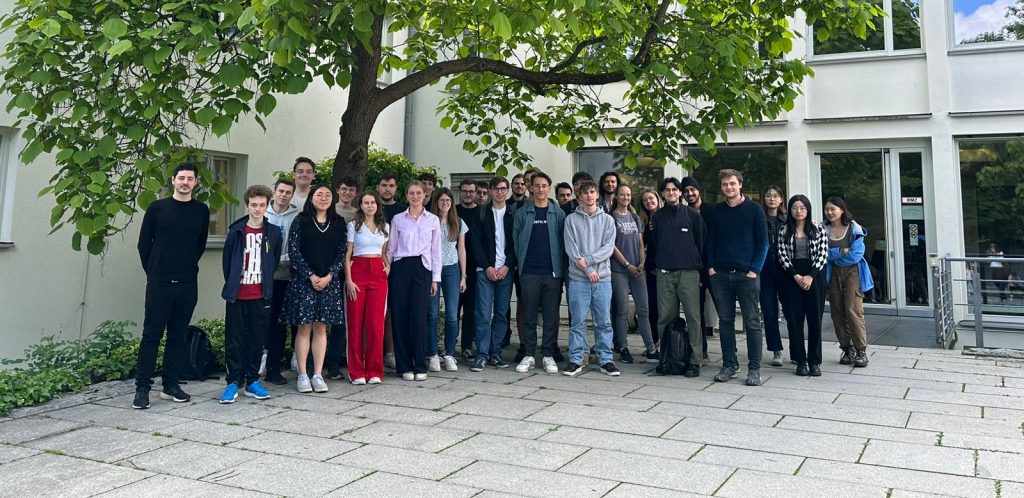
In the Quantum Computing Programming (QCP) practical course  – A QC Optimization Challenge at LMU – we have been collaborating since 2021 with our renowned use-case partners from industry and academia on current quantum computing use-case problems, worked on with and by students.
Selected Use-Case Projects

Surrogate modeling for high-dimensional functions
(with Merck Healthcare KGaA, 2023)

Surrogate models are ubiquitously used in industry and academia to efficiently approximate given black box functions. As state-of-the-art methods from classical machine learning frequently struggle to solve this problem accurately for the often scarce and noisy data sets in practical applications, investigating novel approaches is of great interest. Motivated by recent theoretical results indicating that quantum neural networks (QNNs) have the potential to outperform their classical analogs in the presence of scarce and noisy data, we benchmark their qualitative performance for this scenario empirically. Our contribution displays the first applicationcentered approach of using QNNs as surrogate models on higher dimensional, real world data. When compared to a classical artificial neural network with a similar number of parameters, our QNN demonstrates significantly better results for noisy and scarce data, and thus motivates future work to explore this potential quantum advantage in surrogate modelling. Finally, we demonstrate the performance of current NISQ hardware experimentally and estimate the gate fidelities necessary to replicate our simulation results.

  • Publication: Stein et al., 2023 – Benchmarking Quantum Surrogate Models on Scarce and Noisy Data (arXiv)
Anomaly detection via Quantum Boltzmann Machines
(with Allianz Finance, 2024)

Anomaly detection in Endpoint Detection and Response (EDR) is a critical task in cybersecurity programs of large companies. With rapidly growing amounts of data and the omnipresence of zero-day attacks, manual and rule-based detection techniques are no longer eligible in practice. While classical machine learning approaches to this problem exist, they frequently show unsatisfactory performance in differentiating malicious from benign anomalies. A promising approach to attain superior generalization than currently employed machine learning techniques are quantum generative models. Allowing for the largest representation of data on available quantum hardware, we investigate Quantum Annealing based Quantum Boltzmann Machines (QBMs) for the given problem. We contribute the first fully unsupervised approach for the problem of anomaly detection using QBMs and evaluate its performance on an EDR inspired synthetic dataset. Our results indicate that QBMs can outperform their classical analog (i.e., Restricted Boltzmann Machines) in terms of result quality and training steps in special cases. When employing Quantum Annealers from D-Wave Systems, we conclude that either more accurate classical simulators or substantially more QPU time is needed to conduct the necessary hyperparameter optimization allowing to replicate our simulation results on quantum hardware.

  • Publication: Stein et al., 2024 – Exploring Unsupervised Anomaly Detection with Quantum Boltzmann Machines in Fraud Detection (arXiv)
Quantum Reinforcement Learning Policy-Evaluation
(with Siemens AG, 2025)

Quantum policy evaluation (QPE) is a reinforcement learning (RL) algorithm which is quadratically more efficient than an analogous classical Monte Carlo estimation. It makes use of a direct quantum mechanical realization of a finite Markov decision process, in which the agent and the environment are modeled by unitary operators and exchange states, actions, and rewards in superposition. Previously, the quantum environment has been implemented and parametrized manually for an illustrative benchmark using a quantum simulator. In this paper, we demonstrate how these environment parameters can be learned from a batch of classical observational data through quantum machine learning (QML) on quantum hardware. The learned quantum environment is then applied in QPE to also compute policy evaluations on quantum hardware. Our experiments reveal that, despite challenges such as noise and short coherence times, the integration of QML and QPE shows promising potential for achieving quantum advantage in RL.

  • Publication: Hein et al., 2024 – From Classical Data to Quantum Advantage – Quantum Policy Evaluation on Quantum Hardware (arXiv)

More Use-Case Projecs from the QCP practical course

Energy

  • Graph network optimization (Evonik, 2022)
  • Optimization of unit commitment in energy grids (MunichRE, 2023)
  • Surrogat modeling for production optimization of wind turbines (Siemens 2024)

–

Logistics

  • Job Shop Scheduling (Siemens, 2021) 
  • Anomaly Detection for Endpoint Detection and Response (Allianz, 2022)
  • Call Center Routing Optimization (E-ON 2021)
  • 3D-bin Truck Loading Optimization (SAP, 2024)

–

–

Finance

  • Generative QML for time series forecasting (MunichRE, 2023)
  • Financial Asset Forecasting (BASF, 2023/24)
  • Load Balancing for Virtual Machines (SAP, 2024)
  • Factor-Investing / Portfolio-Construction (Assenagon, 2026)

–

Mobility

  • Bay-Truck Optimization (SAP, 2021)
  • SAT-based optimization of vehicle test-configurations (BMW Group, 2021)
  • Topology optimization (BMW Group, 2023/24)
  • Train Rerouting/Rescheduling (Siemens, 2023/24/25)
  • Vehicle Routing unter time-constraints (Frey Textilreinigung, 2026)

Smart Factory

  • Optimizing steps in metal production (TRUMPF, 2021)
  • Supply chain optimization for seed production (Bayer, 2022)
  • Paint shop optimization (VW Group, 2022)
  • Robotic sequence planning (Byte-Robotics, 2026) 

–

–

Pharmaceuticals

  • Processing and testing of chemical substances in test tubes (BASF, 2021)
  • Surrogate modeling of chemical functions (Merck Healthcare, 2023)
  • Anomaly detection in health monitoring for SAP HANA cloud systems (SAP, 2025)

AI & Machine Learning

  • Multi-class image classification (SAP, 2024/25)
  • Noise aware quantum architecture search (Siemens, 2023)
  • VQC based probability distribution matching (Siemens, 2024)
  • Data-based QC policy evaluation (on QC hardware) (Siemens 2024/25)
  • Generative quantum boltzmann machines (Siemens, 2026)

–

Get started with quantum computing

Take the first step into the next era of computing with the QAR-Lab
Get in touch

QAR-Lab – Quantum Applications and Research Laboratory
Ludwig-Maximilians-Universität München
Oettingenstraße 67
80538 Munich
Phone: +49 89 2180-9153
E-mail: qar-lab@mobile.ifi.lmu.de

© Copyright 2026

General

Team
Contact
Legal notice

Social Media

X-twitter Linkedin Github

Language

  • Deutsch
  • English
Cookie-Zustimmung verwalten
Wir verwenden Cookies, um unsere Website und unseren Service zu optimieren.
Funktional Always active
Die technische Speicherung oder der Zugang ist unbedingt erforderlich für den rechtmäßigen Zweck, die Nutzung eines bestimmten Dienstes zu ermöglichen, der vom Teilnehmer oder Nutzer ausdrücklich gewünscht wird, oder für den alleinigen Zweck, die Übertragung einer Nachricht über ein elektronisches Kommunikationsnetz durchzuführen.
Vorlieben
Die technische Speicherung oder der Zugriff ist für den rechtmäßigen Zweck der Speicherung von Präferenzen erforderlich, die nicht vom Abonnenten oder Benutzer angefordert wurden.
Statistiken
Die technische Speicherung oder der Zugriff, der ausschließlich zu statistischen Zwecken erfolgt. Die technische Speicherung oder der Zugriff, der ausschließlich zu anonymen statistischen Zwecken verwendet wird. Ohne eine Vorladung, die freiwillige Zustimmung deines Internetdienstanbieters oder zusätzliche Aufzeichnungen von Dritten können die zu diesem Zweck gespeicherten oder abgerufenen Informationen allein in der Regel nicht dazu verwendet werden, dich zu identifizieren.
Marketing
Die technische Speicherung oder der Zugriff ist erforderlich, um Nutzerprofile zu erstellen, um Werbung zu versenden oder um den Nutzer auf einer Website oder über mehrere Websites hinweg zu ähnlichen Marketingzwecken zu verfolgen.
Manage options Manage services Manage {vendor_count} vendors Read more about these purposes
Einstellungen anzeigen
{title} {title} {title}